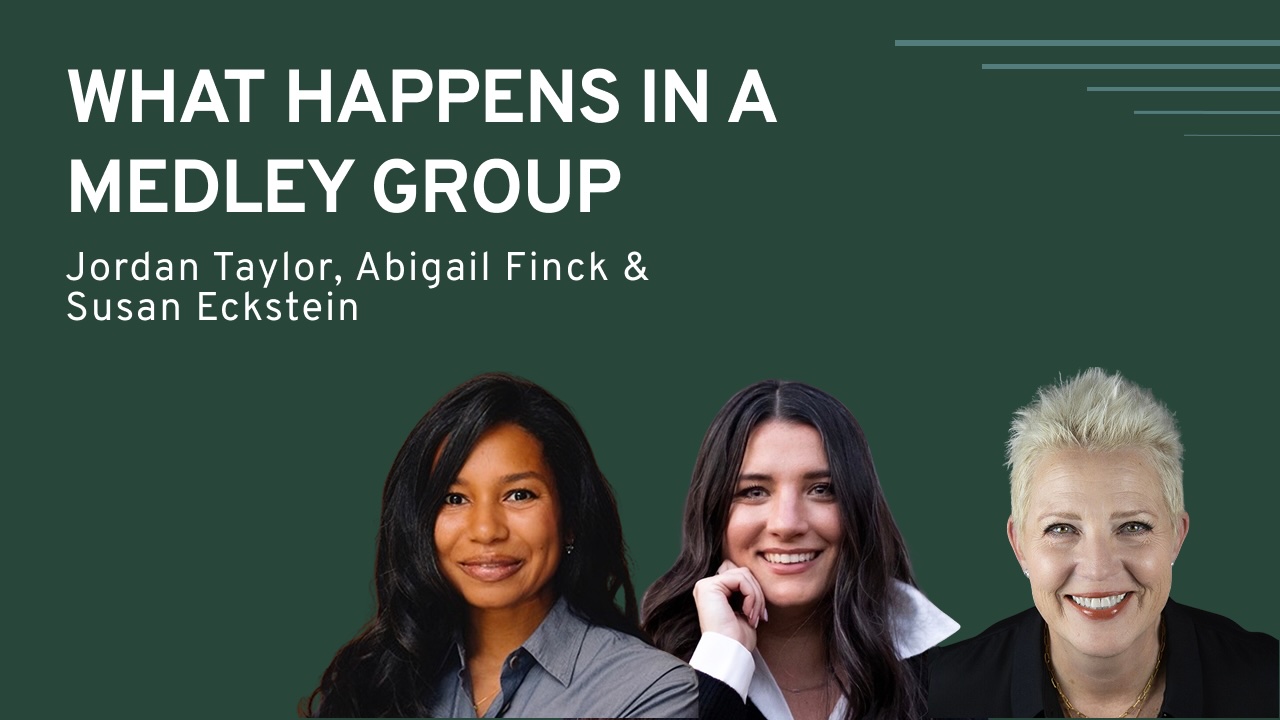
Medley CEO Jordan Taylor, Head of Coaching Abigail Finck, and coach Susan Eckstein share why group coaching is an impactful strategy for leaders navigating this AI Era.

We believe that the most powerful leadership development happens in relationship with other people, and over the past seven years at Medley, we’ve facilitated thousands of group coaching sessions that prove this.
What’s consistently remarkable is how group coaching not only facilitates meaningful shifts within individual leaders, but how those leaders take those insights and transform their teams and organizations for the better.
Recently, Jordan Taylor, CEO and Co-founder of Medley, sat down with Abigail Finck, Head of Coaching, and Susan Eckstein, one of Medley's experienced group coaches, to discuss why group coaching is a critical business strategy for organizations looking to develop leaders who can navigate change and drive organizational transformation, two essential elements of leading during today’s AI Era.
In their conversation, Susan, Jordan and Abigail share what happens in a Medley group and why investing in group coaching delivers returns not just for individual leaders, but for their teams and broader organizations of which they are a part.
Today’s AI Era is full of pressure and challenges, and for many of the leaders we work with, there can be an instinct to project an image of certainty and unwavering confidence, even when they are facing uncertainty and ambiguity in their work and within their organizations.
As Jordan said, “Every leader today is faced with a tension between projecting calm and assurance in this moment of change that we’re in, while also having to grow and adapt ourselves.”
Susan, who has coached hundreds of group sessions, shared that AI integration and transformation consistently come up. She reflected that leaders believe they have to show up calm and with full confidence that they can manage all of this change, while they may simultaneously be experiencing intense pressure, stress or even change fatigue themselves.
The power of group coaching is that it gives participants the opportunity to feel less isolated in their challenges, connect with others undergoing similar experiences in their roles, and take a range of insights back into their work leading teams, departments and even managing themselves.
There’s a common narrative that “soft skills” are important, but the “real work” of leadership is technical, strategic, measurable and maybe even hard-edged. At Medley, we repeatedly prove that not only are “soft skills” foundational to transformational leadership, but they are also the hardest to build without dedicated attention.
“Edith and I have a strong point of view that soft skills are not fluffy or nice to have,” Jordan said. “Soft skills are critical for being able to operate and be commercial in a business environment.”
Indeed, what we’ve seen in our group coaching cohorts is that not only are soft skills like active listening, showing empathy and using a coaching mindset crucial for effective leadership today, but also they are difficult to master on your own as they require intentional focus, practice, and other people.
When leaders come into our groups, they often initially want to develop specific leadership competencies like executive presence, influence, and decision-making. Yes, they will improve in those areas through group coaching. But what we’ve discovered is that the path to those outcomes runs directly through relational “soft” skills.
A leadership growth area we see many executives and leaders bring forth to work on is how to lead with authenticity and effectiveness.
Our Medley Coach Susan shared an example: A CFO in one of her groups wanted to improve her executive presence. Specifically, she wanted to celebrate her team’s wins, but didn't know how to do it and still be taken seriously by the C-suite. The CFO thought she had to choose between being authentic and being credible.
The group asked her: “How would you like to show up?”
That question helped her understand that authentic leadership is about staying true to who you are, but calibrating your presence and approach based on context.
The CFO went back and celebrated her team’s wins in a way that was true to herself, thanks to the insight from her trusted group and coach who challenged her perspective and created space to explore her leadership identity.
Openness is contagious, and this is one of the most consistent things our coaches observe in group coaching. When one person is willing to share what they’re experiencing, others follow. It shifts what’s possible for the whole group.
Susan shared an example that captures how this dynamic drives real leadership growth. She described a C-suite executive who, early in the program, was struck by his group members’ willingness to be honest about their challenges. Inspired by what he saw, he began pushing himself to show up more openly. He practiced sharing his experience across several sessions, building that muscle in real time.
By the end of the program, he was able to share something deeply personal with the group. But the impact didn’t stay in the room. He brought that expanded capacity for openness back to his team by showing up differently as a leader because he’d experienced what it felt like to be truly seen by his peers.
This kind of growth can'’ be manufactured in a workshop or replicated in a 1:1 setting. It emerges from the dynamic of peers choosing, together, to be honest about what leadership actually requires of them.
Medley groups have a built-in flexibility that enables coaches to meet leaders where they are and help them work through challenges that emerge in the moment.
Susan shared an example. She often opens sessions with a series of prompts designed to help people surface what they’re working on or experiencing. In a recent group, someone mentioned “passive disagreement” in response to a question about their team dynamics. Suddenly, the other group members leaned in as were experiencing this too.
Susan asked the group: “Do we want to stay here?”
They said yes. For the next 10 minutes, they explored something none of them expected to talk about, but something they needed to. They discussed how they deal with passive disagreement, how to tell if someone is passively disagreeing, and what do you do upon noticing it.
The key here is that group coaching is not a workshop with a script. While there’s always a “plan,” effective sessions reflect the ability of the coach to sense what’s coming up in the room and to address it so that leaders can work through what they’re actually struggling with rather than overly rely on a pre-determined curriculum.
Accountability is a central feature of Medley’s group coaching.
At the end of each session, each leader commits to something they will do over the next week. This could be a conversation they’re going to have with their team, a pattern they’re going to try to shift, or a way in which they are going to show up differently.
Then between sessions, participants reach out to each other, support each other through that effort, and come back the next week ready to share how it went. When someone accomplishes their goal, the group celebrates it. When the effort doesn’t go as expected, the group helps them unpack it and figure out what to try next.
This sense of accountability is grounded in genuine peer support, not external judgment.
And the lasting impact of group coaching is that this sense of accountability doesn’t disappear when the cohort ends. These leaders now have additional people they can call for support when navigating something hard. The relationships become part of how they lead, which in turn positively shapes the culture of the organization where they work.
The power of group coaching does not remain confined to the specific coaching cohort. Rather, it positively shapes a broader organization.
Susan shared a meaningful insight from a leader in a recent group. The leader said, “I’ve been modeling a behavior that I don’t want my team to do. I see it now, and I’m going to change it.”
The impact of group coaching on an organization can be exponential.
When one leader transforms in a coaching room, their team experiences the benefit of their growth. The team now has a new model through which to work, which can inform a new way of them interacting with their peers.
As such, a single transformation can elevate an entire organization, and it starts in the container of a group.
As a transformation partner, we go deep into the challenges of organizations, and we design a comprehensive and custom coaching and development strategy to support the organization in meeting their goals. We measure our impact along the way to evolve our programming as our partnership deepens.
If you’re a talent or business leader at an organization wrestling with AI transformation, a restructuring, a cultural shift, or all of the above, we’d love to explore together.
Reach out directly through the Medley website or on LinkedIn. We look forward to hearing from you.


.png)
.png)
