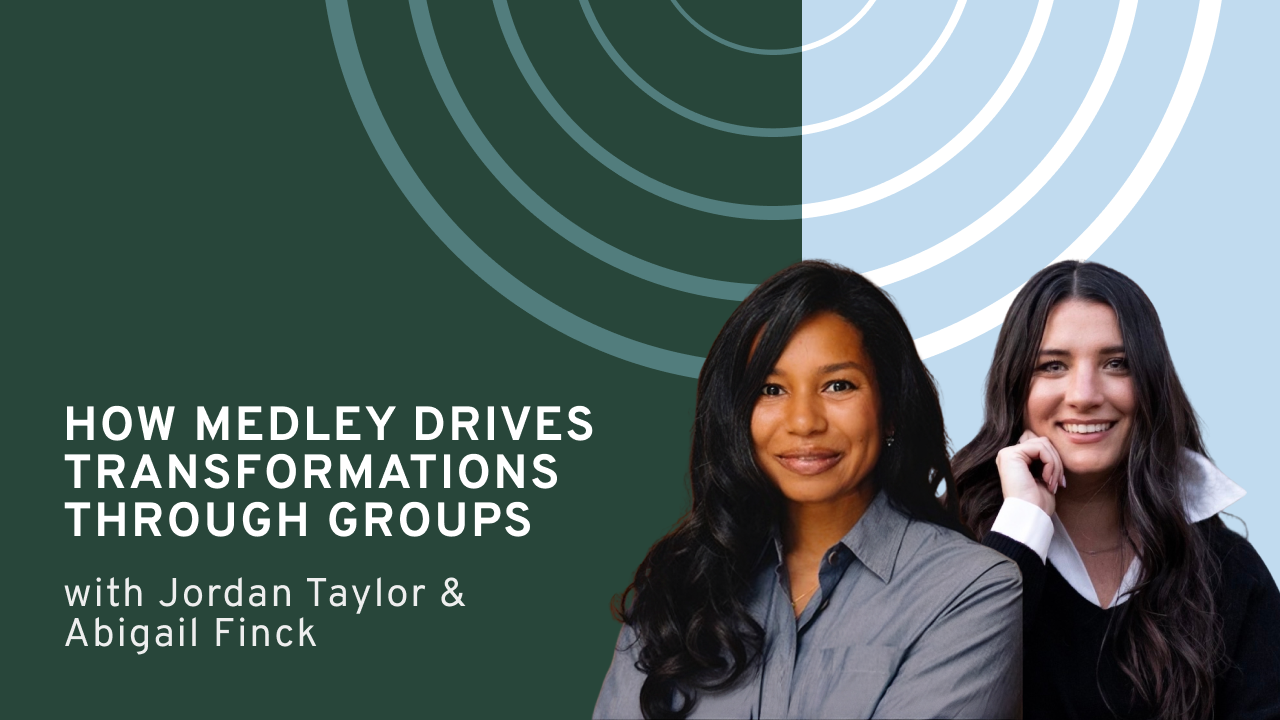
Co-founders Edith Cooper and Jordan Taylor sit down for a Medley Moments conversation on why trust, influence, and human friction matter more than ever, how strong company cultures drive transformatio


Our co-founders Edith Cooper and Jordan Taylor sit down for another Medley Moments to reflect on Medley’s impact in a changing world. In this conversation, Edith and Jordan discuss AI, the importance of company culture, and why human-to-human learning is still critical in developing leaders navigating this moment.
Jordan and Edith launched Medley almost eight years ago under the premise that leaders develop best in a group in the company of peers doing the work together.
Today, as this AI era continues to reshape work and introduce new leadership challenges (and opportunities), the premise hasn’t changed. If anything, it’s become more urgent. The more AI can take on, the more “human” leadership is becoming the differentiator. Building trust with colleagues, influencing and effective communication, and navigating and managing teams and individuals through uncertainty are a few of the key skills that leading in this moment demands. Growing these critical skills is something best done in the context of learning with and from each other, not in isolation.
“The context in which we are all living and operating is pretty extraordinary,” Edith said. “There are many uncertainties and many challenges including the entire complex conversation around AI. That will no doubt change how we think about showing up and operating as individuals in our personal and professional lives.”
The AI transformation story has become much more than a tech story. It's the undercurrent of meaningful workforce change, how leadership is being reshaped under pressure, and how company cultures are working intentionally to adapt to the tech while upholding their values. This is why, as Jordan and Edith discuss, Medley’s approach that harnesses the power of peer connectivity is especially well-suited to meet the moment as it strengthens the trust, empathy, and collaboration skills that are becoming increasingly important for leaders as they navigate this quickly changing world.
As Jordan and Edith discuss, AI is transforming every field, including leadership coaching. And Jordan spoke candidly about what this looks like in some contexts.
“People are starting to use Claude and ChatGPT as leadership coaches. That is happening. Companies are also rolling out AI coaches, like a coach bot that you can reach out to, whether it's via role play or to work through a specific challenge or to be pointed to resources,” she said.
At Medley, we see these AI-driven tools as a meaningful addition to the leadership development landscape, not a threat to it. The strongest organizations we work with aren't choosing between AI coaching and human-led development. They're building both into how they grow their people, using each for what it does well.
Jordan put it directly: “I'm excited by the opportunity AI coaching presents. My perspective is that it will exist in a complementary fashion to human one-on-one coaching and to group coaching.”
That also reflects our integration of AI at Medley. AI plays a strategic role inside our platform by optimizing our group matching process, personalizing curriculum according to the goals of our partners and participants, and streamlining operations so every cohort gets a more relevant, engaging, and impactful experience.
What it doesn't do is replace the human dynamics that drive leadership development, and Jordan was clear about why.
“The core Medley experience is with humans. People come into a Medley group expecting to learn how to be a better manager and better leader. And they do, but they're also leaving with real relationships with their colleagues that continue after the fact.”
Those relationships are core to how growth happens. Working alongside peers enables our participants to develop deeper self-awareness, sharper interpersonal skills, and the ability to hold a big-picture perspective.
“The organizations that are going to win are going to keep their cultures very front and center. And that needs to be done through a really thoughtful approach that helps people build relationships with one another,” Jordan said.
Culture, in other words, isn’t an abstraction. It shows up in how an organization invests in its people. Edith pointed to PwC, a Medley partner, as a clear example. PwC has identified two sets of 15 attributes - 15 human skills, 15 AI fluency skills - as the core capabilities their workforce will need to master in order to thrive in the AI era.
What Edith found striking was the intentionality and discipline behind PwC’s selection of those skills. As Yolanda Seals-Coffield, PwC's U.S. Chief People and Inclusion Officer, shared in a recent Medley Moments conversation, “We could have chosen a hundred skills. But we really zeroed in on these 15.”
For Edith, the deeper shift is that organizations can now define what it means to be a great manager with real specificity. The data has always existed in some form, but surfacing it used to take months of rigorous analytical work. With AI, that codification can happen faster and at scale by enabling organizations to identify and codify the behaviors and capabilities that actually drive performance.
PwC's selection of 15 human skills and 15 AI fluency skills is a glimpse of what that looks like.
But building the list is only the start. The work to be done is committing to those capabilities and following through with the training and coaching needed to develop those capabilities, embedding them into the culture. That's where Medley comes in with partners, supporting leaders in developing the capabilities their organization has decided matter the most.
The numbers speak for Medley's success, and Jordan offered the data point we are especially proud of.
"97% of people who start a Medley group program end up completing the program. And attendance hovers between 85 and 88% across the board," she said.
For busy leaders and executives, those are striking numbers. "People don't want to let down their peers. They don't want to miss out on their group experience."
That sense of community and accountability is built into the group structure. But what makes peer spaces irreplaceable is more than the accountability. It's the relationships that develop between people over time. Yes, Medley participants are building foundational leadership skills. But they are also building trust with peers who understand what it feels like to lead through this moment. They're sharing what's hard, witnessing each other's growth, getting inspired by each other, and leaving the program with connections that continue long after the last session.
"The most valuable part of [my Medley experience] was the opportunity to engage in group discussions that not only helped in developing long-lasting relationships with peers but also significantly improved my business acumen." – Senior Leader at Fortune 200 Client
We're hearing a related theme from our clients: as coaching options — AI-driven and otherwise — become more ubiquitous, they're not looking for more training or resources. They're looking for more meaningful ones. Companies are eager to find ways for people to genuinely build relationships with one another and feel a real sense of belonging inside their organization. That kind of connection is harder to manufacture than access to a chatbot, and it's exactly what social learning within a well-matched peer group creates.
What eight years has confirmed for Medley is that the work of becoming a better leader has gotten more complex, not less. AI is putting new questions in front of every leader: how to lead through change, how to keep teams steady through uncertainty, and how to keep building the human skills that ultimately decide outcomes. But growth itself still happens in the company of other people, with peer accountability, and through practice that's hard to replicate any other way than learning from and with others. That's the work we're going to keep building for.